Issues
Housing
House prices and rents are about 40% higher than they should be versus the 1980's-1990's, on the basis of average incomes. This is a problem that affects virtually all Torontonians; the 80% who can afford their housing but are still paying too much, the 20% who are struggling and the 10,000 who are in shelters.
Most of our children will never be able to afford to live in as-desirable an accommodation as they grew up in. My children certainly can't. It makes me sad and motivated. Aren't we supposed to make the City a better place for our children to live in, not worse? As mentioned above, simply reducing the demand for housing has the greatest potential to reduce housing costs across the board, especially rental prices.
The City already has a huge backlog of applicants for some form of subsidized housing (almost 100,000 families) which will only increase if the City's population increases. There is no way the City will ever be able to fulfill the demand for affordable housing though its current or proposed initiatives, let alone keep up with new arrivals.
Not only that, but there are a couple of dirty little open secrets politicians haven't been mentioning in their platforms. First, agreements for mixed-use affordability housing have a typical life of 40 years, then they all revert to market-rates. What a disaster-in-waiting that is; talk about kicking a problem down the road for our children to deal with. Second, the City tax concessions granted to the developers are so generous that the City is losing an increasingly unsustainable amount of revenue. The City knows this, but only recently started to publish how much it is in their financial statements. It is in effect a hidden annual cost that is being significantly downplayed to the public. We can do better.
There will always be some people who need housing assistance and I support City initiatives to help them, but I would do it very differently than we do now. In fact, there is a very simple way governments could solve the affordability issue almost overnight if they really wanted to; rent vouchers for private rental housing. In fact, there already is an existing program to do this. It's called the Canada-Ontario Housing Benefit (COHB). Unfortunately, annual funding is limited and the program is not open to the general public; it is only available on a referral basis. Why isn't all housing affordability handled this way?
Instead of governments building dedicated community or subsidized housing, qualified applicants would receive an equivalent rent subsidy paid directly to their landlord. This way they have much more choice on where they can live and are not forced to live in community housing projects or in a limited number of subsidized developments.
Of course the problem is always going to come down to funding, which is why politicians don't actually want to do this, it's too open ended a cost, despite all their big talk about affordability being a 'crisis'. I suggest the City sell its portfolio of community housing and surplus City land, invest the funds and use the annual income to fund the rent vouchers. I would make exceptions for seniors housing and supportive housing, particularly for addiction & mental health clients. In theory, governments can then instantly augment the program as much as they want, depending on demand and their finances. However, I agree that the cost is going to be too open-ended and I would cap the program based on the income generated by the investment fund.
I would phase this program in on a voluntary basis first, sell an equivalent number of City buildings to fund it and then proceed from there. I am confident it will be quite popular with residents.
Even though this would be a City initiative, I would allow applicants to live anywhere in Ontario. They can then make the most value of their fixed amount rent voucher by living in a less expensive part of the province. If this initiative works well, I can see the Province incorporating it within the existing COHB program. It's time for Toronto to take the lead.


Transit
The future of transportation in Toronto is public transit, specifically subways....underground ones. Toronto has to stop being so cheap when it comes to building public transit. The Scarborough LRT is a prime example of the cost of being too cheap to build underground. Look what that's costing us now. My heart sinks when I think of the new above ground Eglinton East and Finch West LRT lines and the problems they've had.
Most candidates agree that if we ever want to reduce car use and carbon emissions the City needs to provide transit that is fast, reliable, comfortable and safe, and without removing road space. Only subways can do this. Subways are three times faster than buses and twice as fast as streetcars (on good streetcar days), not to mention more reliable, not affected by traffic, bad weather or perennial track maintenance closing streets. Remember that Toronto built its first two lines when it only had about a million people; surely we can afford to build more of them now.
Streetcars were great when the City was only two million people, I always loved them. Not any more. We have to be realistic, their time has sadly passed; we should have known that when they upgraded to the longer versions. We need to implement a long-term plan to replace all streetcar routes with subways. It might take 20-30 years, so the time to start is now. It'll be a fun project for City planners instead of playing SimCity with our lives by turning the City into a sea of residential towers.
Lastly, we need to make the TTC free of charge. Roads and sidewalks are free, subways should be too. We will never get people out of their cars unless we decrease the cost of the TTC relative to driving, and improve the TTC experience. We could do it all at once, if we can make sure the TTC can carry the additional passengers. Otherwise, we could do it over three years, streetcars first, then subways, then buses. It also will be imperative that passengers have a positive experience in terms of reliability, safety and comfort. I will not spare any expense to ensure this.
I would fund this by; internal savings on not having to collect fares; an increase in street parking permit fees to market rates, a 25-50% sales tax on public parking lot fees (but not on free lots), a 50% increase in parking meter rates, and a flat per-household TTC service fee of $1,000-$500/year. Any remaining shortfall, if any, will be funded out of general revenues. I would phase-in the TTC service fee concurrent with removing fares.
Traffic
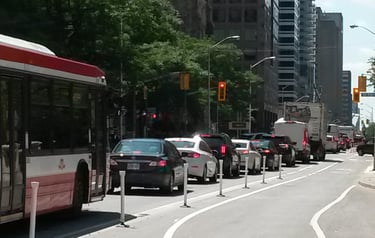
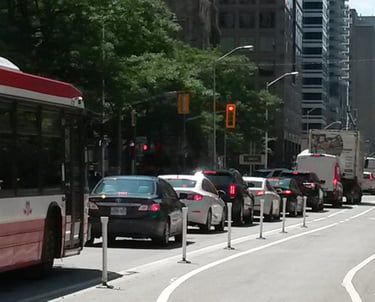
Toronto has a severe case of hardening of the arteries; roads that is. Toronto has the third worst traffic congestion in North America. It didn't used to. I find it incredible that the City thinks it's perfectly OK to double the demand for a vital City service such as road use and yet half the delivery capacity of that service by removing lanes. How is that serving the residents of the City?
Isn't it the responsibility of our city government to improve the quality of life of its residents, in this case by reducing travel times? Over the past 30 years commuting times have become intolerable and the City doesn't even care. In fact, it deliberately implements policies that make things worse; and it never even thought to offer drivers compensation in exchange for expropriating their road access.
I advocate for a general rule that requires two lanes of car traffic on all arterial roads, at all times of day (three lanes in some cases). Parking on arterial roads would go too; that's a luxury only a smaller city can accommodate. If there is any room left over, then we can install bike lanes or parking.
In exchange, I would be willing to spend the money to build cycling specific infrastructure where appropriate. I also think it is fair to make exceptions for bike lanes in a handful of places where the bike demand warrants it, such as Dundas Street east of Broadview Avenue or on Wellesley Street.
I'm still thinking of solutions to improve traffic flow on the DVP, Gardiner and the 401, but I know that a tunnel isn't it.


Homelessness
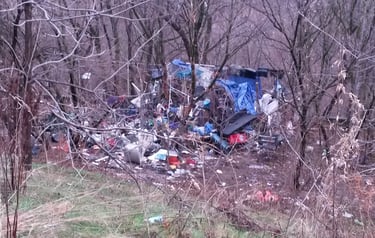
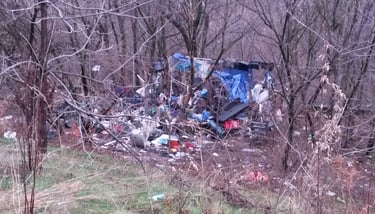
Toronto's homeless population has doubled from about 5,000 in 1998 to 10,000 today, despite all the talk over the past 25 years about the homeless 'crisis'. Politicians aren't solving it because they aren't focused on it and it is virtually out of control. As much as politicians cry about the homeless, they tend to focus mainly on building housing for low-income residents. I understand why; it is much easier to deal with low-income residents because they don't have the mental health, addiction and other issues that 80% of the homeless have. Allowing tent encampments is just a sign that the City has completely given-up on trying to solve this problem.
I don't think there is a one-size-fits-all solution to house the homeless. Some are just in temporary difficulty, others have serious mental health and/or addiction conditions, in addition there is a recent influx of refugees that has seriously strained the shelter capacity.
We need to utilize low-cost accommodation for these people. We just don't have five billion dollars to build $500K apartments for all of them, plus their annual operating costs, plus all those who will follow.
I am a strong supporter of rooming houses, particularly on arterial roads, but this will only work if we can stop the growth that has already removed a significant amount of the rooming house capacity.
I propose using a variety of vacant lands throughout the City to set-up serviced trailer parks to replace all the tent encampments in the City. A trailer is much better than the tents they're living in now and only costs a fraction ($25,000-$50,000) of the cost of building a new apartment. A pilot project could be implemented within a year. They can also be winterized. The Portlands would be a great place to pilot this concept (sorry developers).
Alternatively, vacant office buildings can be cheaply converted into basic shelters with simply individual rooms, but shared facilities like rooming houses have.
We could even buy small used cruise ships if we were really desperate for instant housing.
Those with mental health or addiction conditions should not be housed in the general shelter system. I suggest that these clients be assessed and diverted to specialized shelters/housing with the necessary support services through existing City programs and support partners. We can find the money to fund this; it's finding the professional resources that I think will be the biggest constraint.
I think the time has come to require mandatory intervention to deal with addiction and mental health clients. I do not see how leaving a person with these conditions out on the street without such an intervention can be considered "helping" them.
Lastly, we have to end panhandling on our streets. Either they are already receiving government assistance or they need to be linked-up to the social services system. An expanded Streets to Homes program would be one way of achieving this.
Customer Service
I will prioritize creating a customer service mindset in all City departments and services. (More details to follow)

City finances
I am embarrassed that the richest city in the country struggles to balance its budget and the only solution it can think of is to go begging to the provincial and federal governments for more money. Don't we pay our City Councilors to make the tough decisions?
The City has never implemented a serious belt-tightening over the past 40 years, whereas almost every other major organization in this country has. It's time it did. I think current City expenditures can be cut by as much as 15% and the funds reallocated to pay for subways, support facilities and services for people with mental health and addition conditions, City green transition costs, parks & recreation, reduced development fee revenue, and any other priority initiative.
I cannot provide a thousand specifics here, but as a guideline; I would reduce expenditures that are more generous than those in the private sector; I would cancel initiatives that are nice-to-haves and not must-haves; I would stop various subsidy programs; I would invest in automation wherever possible; I would end activities that are not core municipal functions; operational efficiencies will be looked for and found; I would review the value versus cost of all services and activities; I would remove bidding restrictions that inflate the cost of services contracted to the City; and I would require that certain services charge full rates in order to ensure that revenues cover their costs. This will take a lot of time and focus during my entire term as Mayor.
I also believe that the City leaves a lot of revenue sources on the table. For example, I would lobby for a city capital gains tax of 5-10% on investment property sales, both commercial and residential. In addition, a number of City services are provided at below market rates or are operations that do not charge enough to cover their costs. Revenue rates can be increased accordingly.
The changes will be pretty contentious, as you might expect, but I am prepared to weather the storm in order to make Toronto a better and sustainable place for our children to live.